Trinidad and Tobago’s pharmaceutical sector is being controlled by a handful of dominant companies that exert overwhelming influence over pricing, distribution and access to medication.
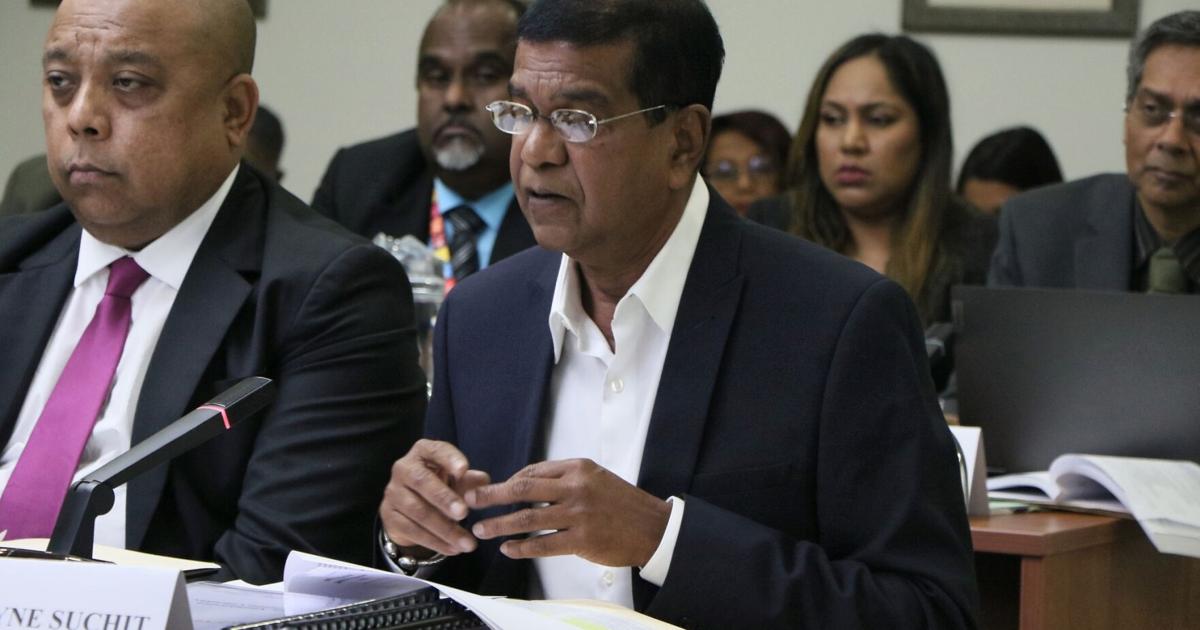
This is according to president of the Private Pharmacy Retail Business Association (PPRBA), Glenwayne Suchit.
Suchit was speaking during a Public Administration and Appropriations Committee (PAAC) hearing at the Red House yesterday, chaired by House Speaker Jagdeo Singh.
The PAAC convened for over two and a half hours yesterday to examine the State’s acquisition of pharmaceuticals, particularly the processes governing importation and approval.
Suchit said that concerns over market monopoly have formed a central pillar of the PPRBA’s work for the past two years.
“Basically, we have just a few major companies that are controlling everything in terms of private procurement for retail distribution and for the public,” he said.
According to Suchit, Aventa Ltd, owned by the Agostini Group, controls 74% of the private pharmaceutical market.
He further stated that Aventa (34%) and Bryden PI (50%) collectively dominate half of the public procurement tender market.
He described the companies’ structure as a vertically integrated ecosystem — one that he said is unacceptable.
Suchit said Aventa owns the SuperPharm and MPharm retail chains, giving it control “from distribution to retail”.
He also disclosed that the company obtained over $100 million in foreign exchange at the EximBank between 2020 and 2025.
He added that more than 59% of the national vend list for Government procurement contracts between 2015 and 2024 was awarded to two companies previously — Smith Robinson (now Aventa) and Bryden PI.
Priced out
Although there are roughly 500 independently owned pharmacies nationwide, Suchit said many are being priced out and facing constraints because of the monopoly.
He said that Aventa and two other dominant distributors collectively control 70% of the wholesale pharmaceutical market.
“That in itself will give you confirmation that we have a serious monopoly in this country controlled by a limited few,” he said.
Suchit accused the major distributors of engaging in unfair trading practices, including denying independent pharmacies access to medications.
He said there is “a pattern of pricing discrimination and refusal to settle supply.”
He recalled that during the Covid-19 pandemic, Aventa supplied Redoxon exclusively to its own outlets.
“Pharmacies were denied this on the grounds that the accountant at Aventa will not sell to pharmacies and take the risk of selling and not getting payment on time and sell all to SuperPharm. That is unfair trading, you cannot decide to sell your own outlets and bypass the other pharmacies in this country. That is ridiculous and nonsense.”
Suchit further alleged that Aventa is “ breaking the law” by advertising Third Schedule drugs with discounted prices through its mobile app.
He said complaints were lodged with former health minister Terrence Deyalsingh, but “nothing was done”.
Turning to the public sector, Suchit criticised Nipdec’s drug storage and procurement management.
He noted the Health Ministry revealed in April that $80 million in drugs had expired, even though he had raised concerns as early as August 2024 about $18 million in expired medication – claims former minister Deyalsingh denied.
Aventa’s reach
PAAC chairman Singh asked Suchit to identify the principal companies shaping the market. Suchit said Aventa owns 13 SuperPharm stores and, following the Agostini Group’s acquisition of Massy’s MPharm, now controls 23 outlets concentrated in urban areas.
Pennywise Cosmetics owns ten pharmacies, he added.
Citing a PPRBA survey, Suchit said that, of 979 products examined, 779 were from Aventa.
He argued that group companies benefit from advantages that allow them to sell medicine at prices even lower than the wholesale rate charged to independent pharmacies.
He provided an example: “If a box of Panadol is sold to private pharmacies for the wholesale price of $20 they then sell it at $19 in their pharmacy chains.
“There is a significant disparity in pricing. We have to keep dropping mark-ups to survive and compete,” he said.
Suchit added that Aventa controls many critical drugs, including cancer medication and treatments for “every imaginable complaint”.
Singh referenced correspondence between a PPRBA attorney and the Fair Trading Commission, noting that the Commission acknowledged the existence of prima facie grounds for investigation yet required the PPRBA to submit a “extensive shopping list” of documents before a probe could begin.




Write a comment
Your email address will not be published. Required fields are marked *